Mechanical Organ Owners Society
Organ Owners News
Support and information for Instrument Owners
We pride ourselves as 'The UK's Friendliest Organ Society'
We pride ourselves as 'The UK's Friendliest Organ Society'
If you know of anyone who owns or is interested in the mechanical organ then please feel free to pass our details on. As a Society promoting and protecting the interests of organ owners and their crews, the larger our membership is the more effectively we can lobby against any legislation which may threaten to restrict our hobby.
Insurance
In the UK the cost of insurance increased on June 1st 2017 when the Insurance Premium Tax rose by 2% to 12%. This affects any new Insurance Policy and will likely mean a higher premium when your Organ Insurance is next due for renewal.
The MOOS scheme is run by the independent company 'Primo plc' (contact Clare Watson on tel: 01702 225452 or email: [email protected]) offers All Risks at 0.4% + IPT with optional £5m Public Liability (minimum premium of £100 + IPT)
The FOPS scheme is run by Sorvio Insurance Brokers Ltd (contact Ian Spalding on tel: 01722 323874 or email: [email protected]) offers All Risks & £2m Public Liability at 0.55% + IPT plus FOPS membership fee with optional £5m Public Liability for a further £25 + IPT.
The MOOS scheme is run by the independent company 'Primo plc' (contact Clare Watson on tel: 01702 225452 or email: [email protected]) offers All Risks at 0.4% + IPT with optional £5m Public Liability (minimum premium of £100 + IPT)
The FOPS scheme is run by Sorvio Insurance Brokers Ltd (contact Ian Spalding on tel: 01722 323874 or email: [email protected]) offers All Risks & £2m Public Liability at 0.55% + IPT plus FOPS membership fee with optional £5m Public Liability for a further £25 + IPT.
PRS License
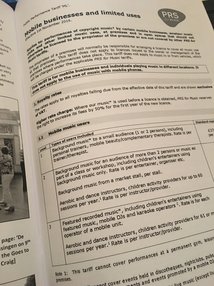
PRS for Music has advised that Tariff ML for ‘Amateur mobile mechanical organ owners’ playing copyright music to or for the public is £32.00 + VAT from 1 November 2016.
This rate is per owner, per year and restricted to amateur enthusiasts.
Further details can be found at the www.prsformusic.com website or by writing to Performing Right Society Ltd, 2 Pancras Square, London. N1C 4AG.
This rate is per owner, per year and restricted to amateur enthusiasts.
Further details can be found at the www.prsformusic.com website or by writing to Performing Right Society Ltd, 2 Pancras Square, London. N1C 4AG.
Risk Assessments
It is becoming more common for event organisers to ask for a completed 'Risk Assessment' from Organ Owners. Basically, you have to think of anything that could cause a risk, while displaying your instrument in a public space. This includes obvious things like generators and cables, but also smaller details like the level of sound, and the safety of your trailer opening canopy.
Our friends at the FOPS have put together an excellent downloadable sheet that you can change and amend. Print out a few copies and keep with you also.
http://www.fops.org/oar/oarguidelines.php
Our friends at the FOPS have put together an excellent downloadable sheet that you can change and amend. Print out a few copies and keep with you also.
http://www.fops.org/oar/oarguidelines.php
Tyre age on goods vehicles
The Department for Transport are proposing to consult on banning tyres more than 10 years old on goods vehicles amongst others. We imagine this will impact on our members who have organs in low-mileage trucks and trailers.
More information here-
https://www.gov.uk/government/news/government-to-consult-on-ban-on-10-year-old-tyres-to-boost-road-safety
More information here-
https://www.gov.uk/government/news/government-to-consult-on-ban-on-10-year-old-tyres-to-boost-road-safety
Testing Historic Vehicles
For the past four years or so, the Department of Transport has been involved in several consultations relevant to Operators Licencing, HGV Periodic Testing and Roadworthiness Testing of Vehicles of Historical Interest. These changes are mostly to bring our legislation into line with EU directives that take effect from 20 May 2018.
There seems to have been quite a lot of confusion over which vehicles will remain exempt, which vehicles will become exempt and which vehicles will now have to be tested.
Firstly, the main two consultations and the outcome of these consultations that will affect the preservation movement are the Department for Transport HGV Periodic Testing and Inspections Exemptions Consultation (2014) and the VHI Consultation on Testing and Inspection September 2016. The outcome of both these Consultations needs to be considered in detail to understand why some previously exempt vehicles will now require testing from May.
Firstly on vehicles of historical interest weighing up to 3.5 tonne. The Law is to change so that all vehicles falling into the historic category (ie. more than 40 years old and not substantially modified after 1988) will be exempt from MOT on a rolling 40 year rule. This will bring the MOT exemption broadly in line with the 40 year existing exemption from road tax (VED).
It will be the responsibility of the keeper of the vehicle to declare and check that their vehicle meets the criteria with reference to substantial change.
The criterion for substantial change guidance as issued is as follows:-
A vehicle will be considered substantially changed if the technical characteristics of the main components have changed in the previous 30 years, unless the changes fall into specific categories. These main components for vehicles, other than motorcycles (*), are:
Chassis (replacements of the same pattern as the original are not considered a substantial change) or Monocoque bodyshell including any sub-frames (replacements of the same pattern as the original are not considered a substantial change);
Axles and running gear – alterations of the type and or method of suspension or steering constitutes a substantial change;
Engine – alternative cubic capacities of the same basic engine and alternative original equipment engines are not considered a substantial change. If the number of cylinders in an engine is different from the original, it is likely to be, but not necessarily, the case that the current engine is not alternative original equipment.
The following are considered acceptable (not substantial) changes if they fall into these specific categories:
. changes that are made to preserve a vehicle, which in all cases must be when original type parts are no longer reasonably available;
. changes of a type, that can be demonstrated to have been made when vehicles of the type were in production or in general use (within ten years of the end of production);
. in respect of axles and running gear changes made to improve efficiency, safety or environmental performance;
. in respect of vehicles that have been commercial vehicles, changes which can be demonstrated were being made when they were used commercially.
In addition if a vehicle (including a motorcycle):
. has been issued with a registration number with a ‘Q’ prefix; or
. is a kit car assembled from components from different makes and model of vehicle; or
. is a reconstructed classic vehicle as defined by DVLA guidance; or
. is a kit conversion, where a kit of new parts is added to an existing vehicle, or old parts are added to a kit of a manufactured body, chassis or monocoque bodyshell changing the general appearance of the vehicle;
it will be considered to have been substantially changed and will not be exempt from MOT testing.
However if any of the four above types of vehicle is taxed as an “historic vehicle” and has not been modified during the previous 30 years, it can be considered as a VHI (Vehicles of Historical Interest).
(*) Further arrangements for motorcycles may be introduced, including if core testing standards are considered further internationally.
For vehicles of historical interest that weigh over 3.5 tonne and buses (with more than 8 seats) there will not be a rolling date exemption, only vehicles manufactured prior to 1960 will be able to claim exemption from roadworthiness testing (again providing they have not been substantially changed after 1988), although they will be able to be exempt from road tax on a rolling 40 year basis providing they are not used commercially and hence for private use can be taxed in the historic vehicle tax class.
The Department of Transport cite their decision not to include vehicles over 3.5 tonne on the perception of associated road safety risk that they might pose, particularly with reference to weight, hence their decision that this date should remain at 1960.
The problem of perception seems to be more and more an everyday occurrence with Government decisions that are based on possibilities and not fact. I personally believe that we have to be very careful that we do not end up legislating ourselves out of many things we enjoy for “possibly” and “might”. Whilst I am the first to accept we must put safety first, you also have to look at the facts and weigh up the consequences.
For instance, if you consult the Department of Transport Impact Assessment 15/9/2016 on the review of vehicles of historical interest roadworthiness testing IA No: DFT00347 page 12 table 3, it lists the number of casualties resulting from reported personal injury road accidents by casualty severity and year of vehicle registration / manufacture, GB: 2014.
Cars, ie. Vehicles below 3.5 tonne, vehicles first registered or manufactured before 1960 up to 1977 account for 5 deaths, 29 serious injuries, 124 slight injuries and 211 damage only cases.
LGV, HGV and buses / coaches over 3.5 tonne vehicles first registered or manufactured before 1960 up to 1977 account for 1 death, 2 serious injury, 16 slight injuries and 25 damage only cases.
This evidence in the DoT’s own document shows clearly the facts in practice, so whilst perception is one thing, fact is another. The vehicles of historical interest with the slightly poorer record will now enjoy the rolling exemption, yet the vehicles with the greater safety record will have to be tested. Of course, there were other statistics on more modern vehicles that were included, that show that actually all types of vehicles of historical interest, compared with modern vehicles, numbers and use, have an excellent safety record, with all vehicles pre 1987 actually only accounting for less than 1% of deaths.
I do not wish to burden the reader with all the statistics; however I think the facts on vehicles of historical interest are important. I pointed out much of this at the time of the consultation and since. However, the decisions have now been made and those of us involved with preserved vehicles have to now work with the new changes.
If the vehicles were being used commercially, then my opinion is that they should be tested, but private preserved commercials have an excellent safety record. Testing them is not likely to improve that record, it is already better than the modern commercial record of vehicles that are tested.
My own opinion is that an historic vehicle is an historic vehicle and a uniform system would have been better and easier to understand and apply, regardless of weight. One of the problems that may have been misleading when these decisions were made, is that many vehicles of historical interest will show weights on their log books that are their train or gross weight from commercial days, not as they are used today unladen in private ownership. A tractor unit from 1970 might show 32 tonne on the log book, in reality when displayed it actually is about 5 – 6 tonne gross, as it is just the unit unladen.
Therefore in many ways the facts may have become a little over played through misconception, as a vehicle of historical interest has to be used unladen to fall into the historic tax category. The Department of Transport do not believe that by putting these vehicles into test it will mean they are taken off the road; this is no doubt true as no enthusiast would knowingly run an unroadworthy vehicle. However if you run an ex Pickford’s locomotive post 1960 which would have been exempt up until May 2018, with a maximum top speed of 25 - 28mph, and you live 50 – 60 miles from a test station, the burden will be great as you will probably have a 2 to 3 hour journey to the test station and then back again, making a whole day of time. For a vehicle that you may only take out 4 or 5 times a year locally. The burden to these owners is going to be greater than it was up to now in time and money.
The reason we now have this situation is because another consultation ran parallel to the VHI consultation, this looked at the exemption from HGV plating and testing. The decision taken by The Department of Transport following this has been to remove many of the previous exemptions.
In removing these exemptions a number of vehicles of historical interest which are post 1960 will no longer be able to claim these exemptions and will become testable from 20 May2018.
Vehicles such as heavy locomotives, light locomotives and motor tractors which had been exempt under section 185 of the road traffic act.
Many post 1960 Scammels, Fodens and ERFs etc. have been exempt from test under this exemption. This type of vehicle was often used by heavy haulage companies like Pickford’s or in showman use. These vehicles have now passed from commercial use in to preservation and we all enjoy viewing them at various events. These vehicles will now be subject to roadworthiness testing if they are post 1960 because of the decision to remove the Locomotive Exemption along with others that had existed within the exemption from roadworthiness testing in Schedule 2 of the Goods Vehicles Plating & Testing Regulations 1988.
Hence, if you are the owner of a post 1960 locomotive or motor tractor you will from May 2018 have to have the vehicle plated and tested. By way of example, this could be a 1961 Scammel Highwayman with a generator fitted ex Showman. The irony of this decision is that when in their working life these vehicles could have been used to tow heavy weight trailers, in some cases over 50 tonne for heavy haulage, they were in fact, never subject to test, falling outside the scope of goods vehicle plating and testing. Now with this change, in their retirement they will be subject to test.
This is not going to be welcome news for the preservationists of these types of post 1960 vehicles, but unfortunately this is the decision the Department of Transport has taken and implemented.
Breakdown vehicles and engineering plant will also be removed from current exemptions, so if your post 1960 vehicle of historic interest had qualified for exemption in either of these categories, you will now have to have the vehicle plated and tested.
Whilst the above situation is regrettable for owners of these preserved vehicles, the changes that will be implemented are not as bad as they could have been.
During this same consultation, the Department of Transport also reviewed the exemption for medical / educational / display vehicles and the decision was taken to keep this category of exemption. This will mean that organ display vehicles that are permanently fitted with a mechanical organ for display will continue to be covered by this exemption. Hence if your post 1960 vehicle is fitted permanently with an organ for display, it will remain exempt from test.
For showmen there will be a new category of exemption for Showman’s vehicles. This category of exemption from testing will only be applicable to showmen and is very explicit in that a “Showman’s vehicle means a vehicle”:-
The Showmans exemption is only applicable to Showmen and not to privately owned ex show vehicles in preservation if they are post 1960.
Steam vehicles will also remain exempt.
If your vehicle is exempt from test it still needs to be in a roadworthy condition and it is your responsibility to ensure your vehicle is kept in a proper roadworthy condition. For those owners who would like to have the roadworthiness of their vehicles checked by an independent party, you can opt to submit your vehicle for test on a voluntary basis.
If your vehicle is no longer exempt and has never been subject to plating and testing in the past you will need to complete a VTG1 form and DVSA will be able to advise on finding a suitable test station.
For those that are worried about meeting modern standards, the Department of Transport have assured me that no vehicle will be tested to standards that do not already apply to it for use on the road and are appropriate for the age of the vehicle.
You can contact DVSA customer contact centre who will be able to advise in relation to these changes. If I can be of assistance to any preservationist in clarifying any of the above, I am only too happy to try to help.
The DVSA are phasing in testing from MAY2018 for newly in scope vehicles and details of the official position including the conditions that must be met for owners taking up this option can be found by searching the DVSA blog at https://movingon.blog.gov.uk
If you wish to view the official substantial change guidance or the consultations they can be reached online, rather than print a long web address that can be incorrectly copied, go to www.gov.uk in the search box type “consultations” and search, in the next window click on the top link “ publications: consultations” then on the left side box in “All Policy Areas” click on transport, you can then scroll down to find the relevant documents dated 18th December 2017 and 14th September 2017.
I for one hope that the decisions made by The Department of Transport does not lead to us seeing a reduction of this type of vehicle at shows. Vehicles from the 1960 to 1980 period are a crucial part of our history and some of the more specialist transport, like locomotives as used by showmen and heavy haulage companies, and the way they were used, is an important part of our social history and demonstrates the type of vehicle that has all but gone today. With a few exceptions, much of the fairground industry and specialist heavy haulage companies have replaced these vehicles with more modern transport.
From MOOS Member Richard Dean. February 2018.
There seems to have been quite a lot of confusion over which vehicles will remain exempt, which vehicles will become exempt and which vehicles will now have to be tested.
Firstly, the main two consultations and the outcome of these consultations that will affect the preservation movement are the Department for Transport HGV Periodic Testing and Inspections Exemptions Consultation (2014) and the VHI Consultation on Testing and Inspection September 2016. The outcome of both these Consultations needs to be considered in detail to understand why some previously exempt vehicles will now require testing from May.
Firstly on vehicles of historical interest weighing up to 3.5 tonne. The Law is to change so that all vehicles falling into the historic category (ie. more than 40 years old and not substantially modified after 1988) will be exempt from MOT on a rolling 40 year rule. This will bring the MOT exemption broadly in line with the 40 year existing exemption from road tax (VED).
It will be the responsibility of the keeper of the vehicle to declare and check that their vehicle meets the criteria with reference to substantial change.
The criterion for substantial change guidance as issued is as follows:-
A vehicle will be considered substantially changed if the technical characteristics of the main components have changed in the previous 30 years, unless the changes fall into specific categories. These main components for vehicles, other than motorcycles (*), are:
Chassis (replacements of the same pattern as the original are not considered a substantial change) or Monocoque bodyshell including any sub-frames (replacements of the same pattern as the original are not considered a substantial change);
Axles and running gear – alterations of the type and or method of suspension or steering constitutes a substantial change;
Engine – alternative cubic capacities of the same basic engine and alternative original equipment engines are not considered a substantial change. If the number of cylinders in an engine is different from the original, it is likely to be, but not necessarily, the case that the current engine is not alternative original equipment.
The following are considered acceptable (not substantial) changes if they fall into these specific categories:
. changes that are made to preserve a vehicle, which in all cases must be when original type parts are no longer reasonably available;
. changes of a type, that can be demonstrated to have been made when vehicles of the type were in production or in general use (within ten years of the end of production);
. in respect of axles and running gear changes made to improve efficiency, safety or environmental performance;
. in respect of vehicles that have been commercial vehicles, changes which can be demonstrated were being made when they were used commercially.
In addition if a vehicle (including a motorcycle):
. has been issued with a registration number with a ‘Q’ prefix; or
. is a kit car assembled from components from different makes and model of vehicle; or
. is a reconstructed classic vehicle as defined by DVLA guidance; or
. is a kit conversion, where a kit of new parts is added to an existing vehicle, or old parts are added to a kit of a manufactured body, chassis or monocoque bodyshell changing the general appearance of the vehicle;
it will be considered to have been substantially changed and will not be exempt from MOT testing.
However if any of the four above types of vehicle is taxed as an “historic vehicle” and has not been modified during the previous 30 years, it can be considered as a VHI (Vehicles of Historical Interest).
(*) Further arrangements for motorcycles may be introduced, including if core testing standards are considered further internationally.
For vehicles of historical interest that weigh over 3.5 tonne and buses (with more than 8 seats) there will not be a rolling date exemption, only vehicles manufactured prior to 1960 will be able to claim exemption from roadworthiness testing (again providing they have not been substantially changed after 1988), although they will be able to be exempt from road tax on a rolling 40 year basis providing they are not used commercially and hence for private use can be taxed in the historic vehicle tax class.
The Department of Transport cite their decision not to include vehicles over 3.5 tonne on the perception of associated road safety risk that they might pose, particularly with reference to weight, hence their decision that this date should remain at 1960.
The problem of perception seems to be more and more an everyday occurrence with Government decisions that are based on possibilities and not fact. I personally believe that we have to be very careful that we do not end up legislating ourselves out of many things we enjoy for “possibly” and “might”. Whilst I am the first to accept we must put safety first, you also have to look at the facts and weigh up the consequences.
For instance, if you consult the Department of Transport Impact Assessment 15/9/2016 on the review of vehicles of historical interest roadworthiness testing IA No: DFT00347 page 12 table 3, it lists the number of casualties resulting from reported personal injury road accidents by casualty severity and year of vehicle registration / manufacture, GB: 2014.
Cars, ie. Vehicles below 3.5 tonne, vehicles first registered or manufactured before 1960 up to 1977 account for 5 deaths, 29 serious injuries, 124 slight injuries and 211 damage only cases.
LGV, HGV and buses / coaches over 3.5 tonne vehicles first registered or manufactured before 1960 up to 1977 account for 1 death, 2 serious injury, 16 slight injuries and 25 damage only cases.
This evidence in the DoT’s own document shows clearly the facts in practice, so whilst perception is one thing, fact is another. The vehicles of historical interest with the slightly poorer record will now enjoy the rolling exemption, yet the vehicles with the greater safety record will have to be tested. Of course, there were other statistics on more modern vehicles that were included, that show that actually all types of vehicles of historical interest, compared with modern vehicles, numbers and use, have an excellent safety record, with all vehicles pre 1987 actually only accounting for less than 1% of deaths.
I do not wish to burden the reader with all the statistics; however I think the facts on vehicles of historical interest are important. I pointed out much of this at the time of the consultation and since. However, the decisions have now been made and those of us involved with preserved vehicles have to now work with the new changes.
If the vehicles were being used commercially, then my opinion is that they should be tested, but private preserved commercials have an excellent safety record. Testing them is not likely to improve that record, it is already better than the modern commercial record of vehicles that are tested.
My own opinion is that an historic vehicle is an historic vehicle and a uniform system would have been better and easier to understand and apply, regardless of weight. One of the problems that may have been misleading when these decisions were made, is that many vehicles of historical interest will show weights on their log books that are their train or gross weight from commercial days, not as they are used today unladen in private ownership. A tractor unit from 1970 might show 32 tonne on the log book, in reality when displayed it actually is about 5 – 6 tonne gross, as it is just the unit unladen.
Therefore in many ways the facts may have become a little over played through misconception, as a vehicle of historical interest has to be used unladen to fall into the historic tax category. The Department of Transport do not believe that by putting these vehicles into test it will mean they are taken off the road; this is no doubt true as no enthusiast would knowingly run an unroadworthy vehicle. However if you run an ex Pickford’s locomotive post 1960 which would have been exempt up until May 2018, with a maximum top speed of 25 - 28mph, and you live 50 – 60 miles from a test station, the burden will be great as you will probably have a 2 to 3 hour journey to the test station and then back again, making a whole day of time. For a vehicle that you may only take out 4 or 5 times a year locally. The burden to these owners is going to be greater than it was up to now in time and money.
The reason we now have this situation is because another consultation ran parallel to the VHI consultation, this looked at the exemption from HGV plating and testing. The decision taken by The Department of Transport following this has been to remove many of the previous exemptions.
In removing these exemptions a number of vehicles of historical interest which are post 1960 will no longer be able to claim these exemptions and will become testable from 20 May2018.
Vehicles such as heavy locomotives, light locomotives and motor tractors which had been exempt under section 185 of the road traffic act.
Many post 1960 Scammels, Fodens and ERFs etc. have been exempt from test under this exemption. This type of vehicle was often used by heavy haulage companies like Pickford’s or in showman use. These vehicles have now passed from commercial use in to preservation and we all enjoy viewing them at various events. These vehicles will now be subject to roadworthiness testing if they are post 1960 because of the decision to remove the Locomotive Exemption along with others that had existed within the exemption from roadworthiness testing in Schedule 2 of the Goods Vehicles Plating & Testing Regulations 1988.
Hence, if you are the owner of a post 1960 locomotive or motor tractor you will from May 2018 have to have the vehicle plated and tested. By way of example, this could be a 1961 Scammel Highwayman with a generator fitted ex Showman. The irony of this decision is that when in their working life these vehicles could have been used to tow heavy weight trailers, in some cases over 50 tonne for heavy haulage, they were in fact, never subject to test, falling outside the scope of goods vehicle plating and testing. Now with this change, in their retirement they will be subject to test.
This is not going to be welcome news for the preservationists of these types of post 1960 vehicles, but unfortunately this is the decision the Department of Transport has taken and implemented.
Breakdown vehicles and engineering plant will also be removed from current exemptions, so if your post 1960 vehicle of historic interest had qualified for exemption in either of these categories, you will now have to have the vehicle plated and tested.
Whilst the above situation is regrettable for owners of these preserved vehicles, the changes that will be implemented are not as bad as they could have been.
During this same consultation, the Department of Transport also reviewed the exemption for medical / educational / display vehicles and the decision was taken to keep this category of exemption. This will mean that organ display vehicles that are permanently fitted with a mechanical organ for display will continue to be covered by this exemption. Hence if your post 1960 vehicle is fitted permanently with an organ for display, it will remain exempt from test.
For showmen there will be a new category of exemption for Showman’s vehicles. This category of exemption from testing will only be applicable to showmen and is very explicit in that a “Showman’s vehicle means a vehicle”:-
- Registered under this Act in the name of a person following the business of a travelling showman and
- Used solely by him for the purposes of his business and for no other purpose.
The Showmans exemption is only applicable to Showmen and not to privately owned ex show vehicles in preservation if they are post 1960.
Steam vehicles will also remain exempt.
If your vehicle is exempt from test it still needs to be in a roadworthy condition and it is your responsibility to ensure your vehicle is kept in a proper roadworthy condition. For those owners who would like to have the roadworthiness of their vehicles checked by an independent party, you can opt to submit your vehicle for test on a voluntary basis.
If your vehicle is no longer exempt and has never been subject to plating and testing in the past you will need to complete a VTG1 form and DVSA will be able to advise on finding a suitable test station.
For those that are worried about meeting modern standards, the Department of Transport have assured me that no vehicle will be tested to standards that do not already apply to it for use on the road and are appropriate for the age of the vehicle.
You can contact DVSA customer contact centre who will be able to advise in relation to these changes. If I can be of assistance to any preservationist in clarifying any of the above, I am only too happy to try to help.
The DVSA are phasing in testing from MAY2018 for newly in scope vehicles and details of the official position including the conditions that must be met for owners taking up this option can be found by searching the DVSA blog at https://movingon.blog.gov.uk
If you wish to view the official substantial change guidance or the consultations they can be reached online, rather than print a long web address that can be incorrectly copied, go to www.gov.uk in the search box type “consultations” and search, in the next window click on the top link “ publications: consultations” then on the left side box in “All Policy Areas” click on transport, you can then scroll down to find the relevant documents dated 18th December 2017 and 14th September 2017.
I for one hope that the decisions made by The Department of Transport does not lead to us seeing a reduction of this type of vehicle at shows. Vehicles from the 1960 to 1980 period are a crucial part of our history and some of the more specialist transport, like locomotives as used by showmen and heavy haulage companies, and the way they were used, is an important part of our social history and demonstrates the type of vehicle that has all but gone today. With a few exceptions, much of the fairground industry and specialist heavy haulage companies have replaced these vehicles with more modern transport.
From MOOS Member Richard Dean. February 2018.